
Monthly Market Wrap September 2026
Greed In Crypto, Higher Yields Everywhere
September ended with a familiar mix: markets looking calm on the surface, and quietly tense underneath. The S&P 500 rose 1.12% while the VIX climbed 5.12% to 16.23, a combination that tends to produce choppy follow-through rather than clean trends. In crypto, Bitcoin slipped 2.43% over seven days to $83,837 and Ethereum fell 1.56% to $2,695, the kind of cooling that tests whether investors are allocating with a plan or reacting to a colour on the screen. The standout detail was sentiment: Crypto Fear and Greed sits at 71, even as a handful of tokens sprinted far ahead of the broader market.
News Digest
European investors can now access Bitcoin with less U.S. dollar risk: New investment routes give European investors access to Bitcoin with less embedded USD exposure. This removes a practical source of currency risk, particularly when exchange rates and digital assets are moving sharply.
Bitcoin ETFs extend $3.1B inflow streak as Ether funds turn red: Bitcoin ETFs continued to attract capital while Ether ETFs recorded net outflows. The split points to stronger demand for Bitcoin rather than broad confidence across the digital-asset market.
Standard Chartered initiates ENA coverage as BTC waits for U.S. inflation data: Standard Chartered began covering ENA as markets waited for fresh U.S. inflation data. Institutional attention could bring more liquidity and visibility to the asset, while inflation figures may set the broader market direction.
U.S. crypto ETF inflows cool after a $3.3B week: ETF inflows slowed after a strong week but remained positive. The shift suggests demand is still present, although the pace has moderated and the market may be entering a period of consolidation.
European stablecoin issuer AllUnity launches USDAU: AllUnity launched a new USD stablecoin in Europe, adding to the growth of regulated digital-asset infrastructure. More stablecoin options could make it easier to hold and move capital between market positions.
The Macro Lens
U.S. financial conditions tightened slightly, even as equities held firm. The U.S. 10-year Treasury yield rose 4.97% to 5.255%, raising the return available from lower-risk assets and making speculative investments compete harder for capital. This helps explain why positive market news has not always produced sustained gains.
The VIX also rose 5.12% to 16.23. A rising volatility index alongside a rising S&P 500 often means investors are staying invested while paying more for protection. Confidence is still present, but it is becoming more conditional.
Gold’s 1.40% rise to $4,184.68 fits the same pattern. Its strength during a positive week for equities suggests portfolios are still looking for protection rather than fully embracing a risk-on environment. In currency markets, EUR/USD fell 0.27% to 1.1340, while USD/JPY stood at 157.43. The firm dollar added another constraint on global liquidity, even without a usable DXY reading.
The Stocks Lens
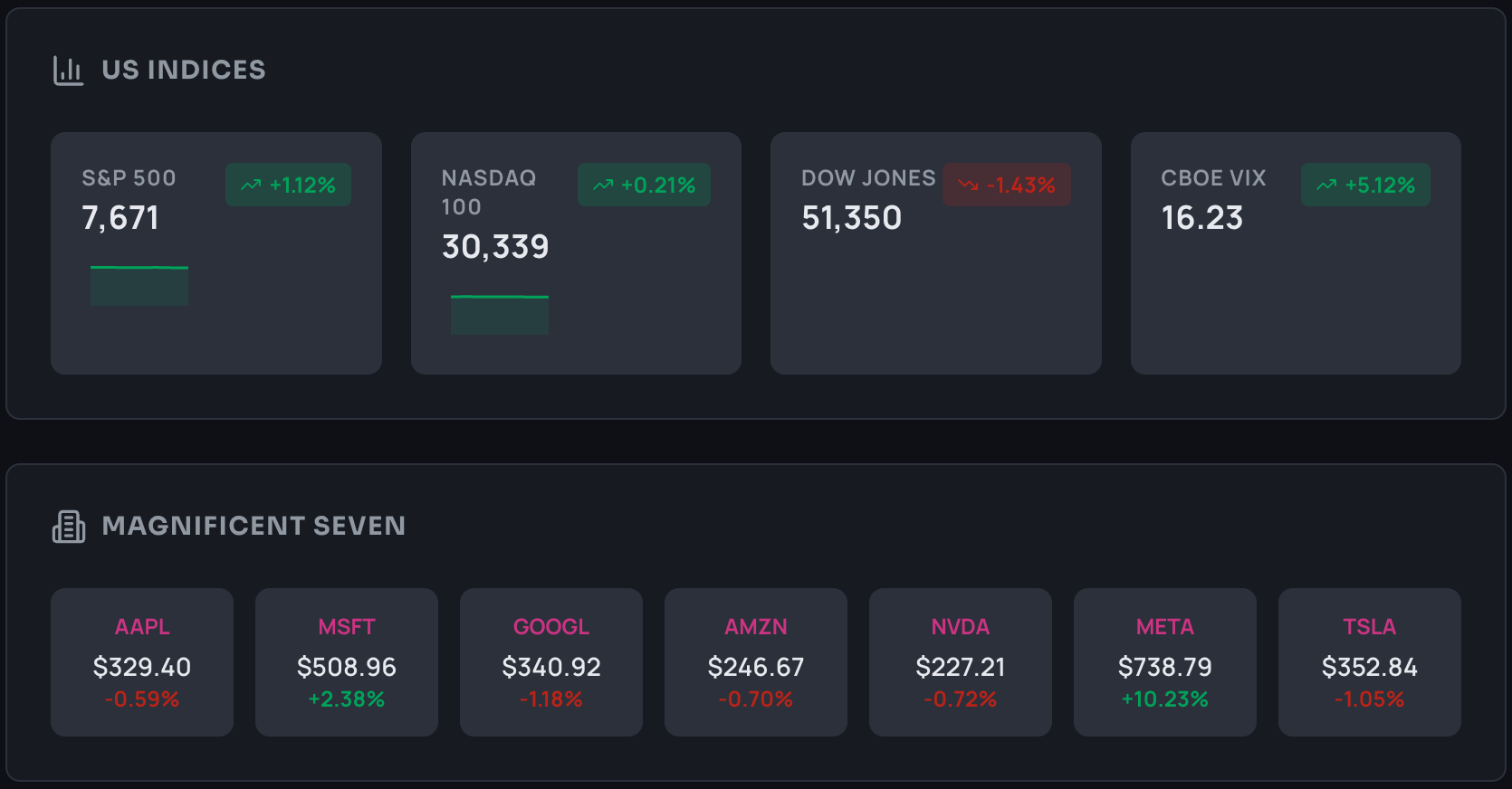
US equities told a “headline up, nerves up” story. The S&P 500 gained 1.12% to 7,670.84 while the Nasdaq 100 added 0.21% to 30,339.33, but the Dow fell 1.43% to 51,349.92, a split that usually shows investors rotating inside the market rather than adding broad exposure. When leadership narrows, portfolios often experience more dispersion and less forgiveness for crowded ideas.
Within mega-cap tech, the winners and losers were not subtle. Meta jumped 10.23% to $738.79 and Microsoft rose 2.38% to $508.96, while Alphabet fell 1.18% to $340.92 and Tesla slipped 1.05% to $352.84. This kind of stock-by-stock divergence tends to spill into crypto as selective appetite: investors keep paying up for clear earnings narratives and clear adoption stories, while punishing anything that looks like “promise now, profits later.”
That link matters because crypto often behaves like the most sensitive end of global risk appetite. When equities reward clarity and penalize uncertainty, crypto’s beta shows up as rotation toward Bitcoin and away from the long tail.
The Crypto Lens
Crypto finished the month with optimism that looks more selective than broad. Bitcoin traded around $83,837, down 0.67% on the day and 2.43% on the week, a pullback size that often exposes the difference between long-term allocation and short-term conviction. Ethereum at $2,695 was down 1.31% in 24 hours and 1.56% over seven days, and the ETH/BTC ratio at 0.0321 captures that relative weakness in one clean line.
Institutional flow data reinforced the same hierarchy. Bitcoin ETFs saw $66.19 million of net inflows on September 29 and a 9-session inflow streak, the type of steady demand that tends to support “hold it as a core” behavior even when price chops around. Ethereum spot ETFs recorded a $2.81 million net outflow the same day, and BlackRock’s ETHA showed an $8.94 million outflow, a reminder that even large, well-known assets can face short-term preference shifts.
Market structure added another clue. Bitcoin dominance at 58.3% points to consolidation toward liquidity, and Crypto Fear and Greed at 71 shows investors feeling good while still preferring the simplest exposure. That combination often produces bursts of altcoin excitement without a durable broad rally.


Notable Outliers
The biggest tell in crypto this month was not Bitcoin’s small weekly decline. It was the gap between the index-level market and the outliers. Quant (QNT) rose 26.04% in 24 hours and 319.12% over seven days, a move that usually reflects a crowded rotation where investors chase a single story with urgency. SOON gained 34.77% in 24 hours and 115.48% in seven days, and Midnight (NIGHT) added 21.17% on the day and 51.96% on the week, a pattern consistent with narrative-led bursts rather than broad liquidity expansion.
A second tier followed. Shuffle (SHFL) rose 9.06% in 24 hours and 79.36% over seven days, while Grass (GRASS) gained 5.97% on the day and 58.19% on the week. When several mid-cap tokens rally hard while BTC and ETH drift, the market is often rewarding specificity and punishing anything that feels like “generic beta.”
Sector Spotlight
AI-adjacent and “infrastructure with a story” tokens kept pulling capital, even as BTC and ETH cooled. You can see it in the concentration of extreme weekly moves: QNT up 319.12% in seven days and SOON up 115.48% are not normal conditions for a mature, broad-based risk-on tape. They are the signature of a market where liquidity hunts for a reason to be active.
This matters because selective froth changes investor behavior. When a few tokens produce triple-digit weeks, portfolios without a clear allocation rule tend to drift into late-cycle decisions: selling boring core exposure to fund the exciting thing that already moved. Meanwhile, BTC dominance at 58.3% shows the market still treating Bitcoin as the balance sheet asset of crypto. That split often persists longer than expected, with “core consolidation” and “micro manias” running side by side.
The Contrarian Take
Crypto Fear and Greed at 71 often tempts investors into the cleanest mistake: confusing a good mood for a stable regime. Sentiment can stay elevated while the market gets more fragile, especially when the same week features Bitcoin down 2.43% and a token like QNT up 319.12%. That is not broad strength, it is concentrated excitement.
The underappreciated risk is correlation arriving late. In weeks where the US 10Y yield jumps to 5.255 and the VIX rises to 16.23, markets can look fine until they do not, because investors are still fully invested while quietly buying protection. If that protection demand turns into de-risking, the long tail of crypto usually feels it first, regardless of how good the narrative sounded a week earlier.
The ICONOMI Angle
The strongest ICONOMI performers this month were loud in returns, and even louder in what they reveal about risk concentration.
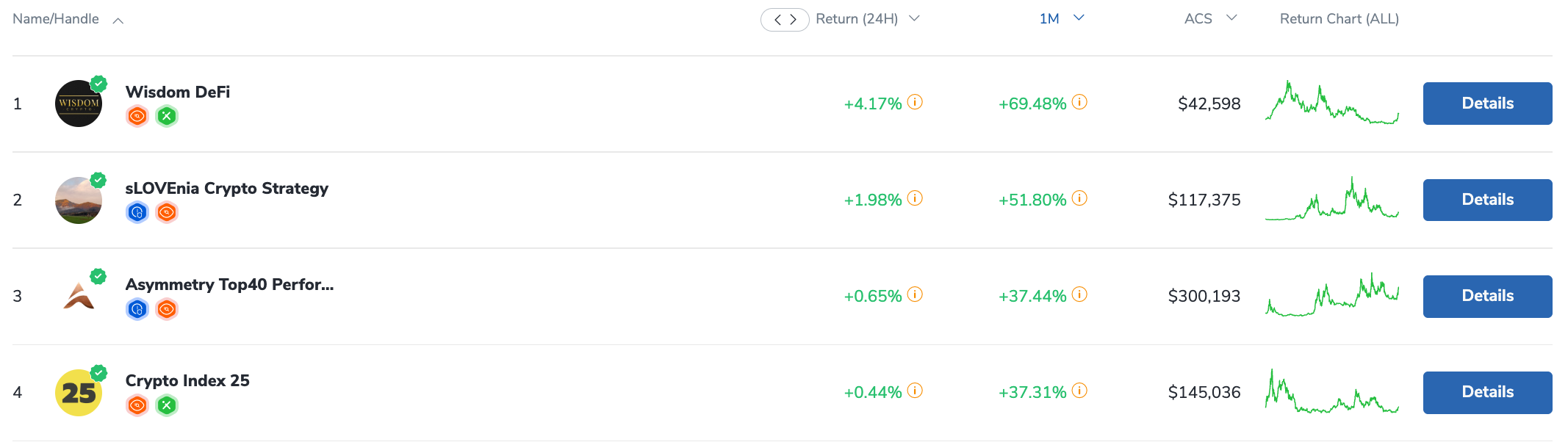
Wisdom DeFi delivered a 30-Day Return of +69.48% with Top Holdings of HYPE 9.8%, LINK 9.9%, and XLM 10.0%, which reads like a portfolio built to benefit when speculative pockets heat up even if the majors cool. sLOVEnia Crypto Strategy returned +51.80% with Top Holdings led by ENA 51.6%, a reminder that a single dominant holding can drive results quickly in both directions when narrative momentum accelerates.
By contrast, strategies that look more like broad-market baskets still posted strong months without relying on one name. Asymmetry Top40 Performance returned +37.44% with BTC 5.7%, HYPE 5.2%, and LINK 5.8% among Top Holdings, while Crypto Index 25 returned +37.31% with BTC 3.2%, ETH 3.3%, and BNB 3.3%.
The spread between +69.48% and +37.31% is the month’s real story: concentrated themes beat diversified exposure when micro-trends dominate tape action.
The Month Ahead
Upcoming U.S. inflation data: macro volatility catalyst for equities, yields, and crypto risk appetite.
Daily BTC and ETH ETF flow prints: confirms whether flow divergence persists.
Stablecoin adoption signals in Europe: early read on regulated on-chain demand.
Major AI-token product launches: narrative catalysts that often amplify dispersion.
What to Watch Next
One thing to watch is whether the “higher yields, higher caution” mix persists. The US 10Y yield at 5.255 and the VIX at 16.23 can coexist with rising equities for a while, but sustained increases often show up as narrower leadership and more abrupt risk resets. Confirmation looks like another leg higher in yields alongside further VIX strength. A contradiction looks like yields easing while volatility demand cools.
ETF flow divergence is another clean signpost. Bitcoin ETFs taking in $66.19 million on September 29 while Ethereum ETFs posted a $2.81 million net outflow highlights preference, not verdict. Whether that preference becomes a lasting trend depends on whether BTC inflow streaks continue while ETH stabilizes, or whether both converge toward flat flows.
Within crypto, dispersion is the story to monitor. Bitcoin dominance at 58.3% suggests the market is still paying for liquidity, even as QNT gained 319.12% in seven days and SOON rose 115.48%. Confirmation looks like dominance staying elevated while outliers keep running. A contradiction looks like dominance falling alongside broad altcoin participation, which would signal a different kind of risk regime.
FAQs
Is Crypto Fear and Greed at 71 a warning sign?
Crypto Fear and Greed at 71 signals elevated optimism, which often coincides with more impulsive decision-making. It does not predict an immediate reversal, but it often appears when investors feel comfortable taking extra risk, especially in smaller tokens with limited liquidity.
Why can Bitcoin fall while some altcoins surge 100%+ in a week?
Altcoins can surge while Bitcoin drifts because liquidity rotates into specific narratives rather than lifting the whole market. Bitcoin dominance at 58.3% shows capital still concentrating in the largest asset, even as pockets like QNT (+319.12% 7d) attract speculative bursts.
Do ETF inflows and outflows matter for crypto prices?
ETF flows matter because they reflect persistent demand from a large buyer base that often behaves differently from retail traders. Bitcoin ETFs saw $66.19 million of net inflows on September 29, while Ethereum ETFs saw a $2.81 million net outflow, which can reinforce relative performance gaps over short windows.

Ready to start your journey with us?
Trusted by over 100,000 users from around the world.