
Monthly Market Wrap August 2026
When Institutional Inflows Fuel Greed: Balancing Momentum with Discipline
This month's market narrative saw institutional capital flowing into digital assets, pushing the crypto Fear & Greed Index firmly into "Greed."
Bitcoin surged towards $80,000 while major altcoins followed. Meanwhile, traditional equities presented a mixed picture, with tech gains offset by broader market hesitation. For investors, this period highlights the tension between chasing momentum and maintaining a structured approach.
The real work is in understanding what these movements mean for long-term allocation, not in reacting to daily price swings.
News Digest
XRP-backed company nearing Nasdaq listing: An XRP treasury company, backed by Ripple, is on the verge of a Nasdaq listing after its SEC registration became effective. This move signals increasing mainstream financial integration for a prominent digital asset, potentially expanding its liquidity and visibility for investors.
Nvidia earnings boost risk assets: Nvidia's strong earnings results provided a tailwind to tech-heavy markets, a sentiment that extended to Bitcoin. This highlights the growing correlation between robust tech performance and broader risk-on appetite, which can benefit diversified portfolios including digital assets.
Charles Schwab adds Solana, Avalanche, Chainlink to platform: The inclusion of these altcoins by a major traditional brokerage firm expands access for both retail and institutional investors. This move suggests increasing institutional adoption beyond just Bitcoin and Ethereum, broadening the legitimization of a wider range of digital assets within investment portfolios.
Jackson Hole speech watch: All eyes are on the upcoming Jackson Hole Symposium, particularly for Federal Reserve comments on future monetary policy. Such statements are pivotal for shaping global financial conditions and can influence investor appetite across traditional and digital asset classes, making careful monitoring a key part of any allocation strategy.
UAE investor backs Trump family's crypto bank: A prominent UAE investor's backing of the Trump family's crypto bank venture indicates increasing involvement of influential global capital in the digital asset space. This points to the evolving intersection of geopolitics, traditional finance, and digital assets, underlining the growing institutional interest.
The Macro Lens
The broader market sentiment remains complex, characterized by both cautious optimism in traditional finance and sustained institutional interest in digital assets.
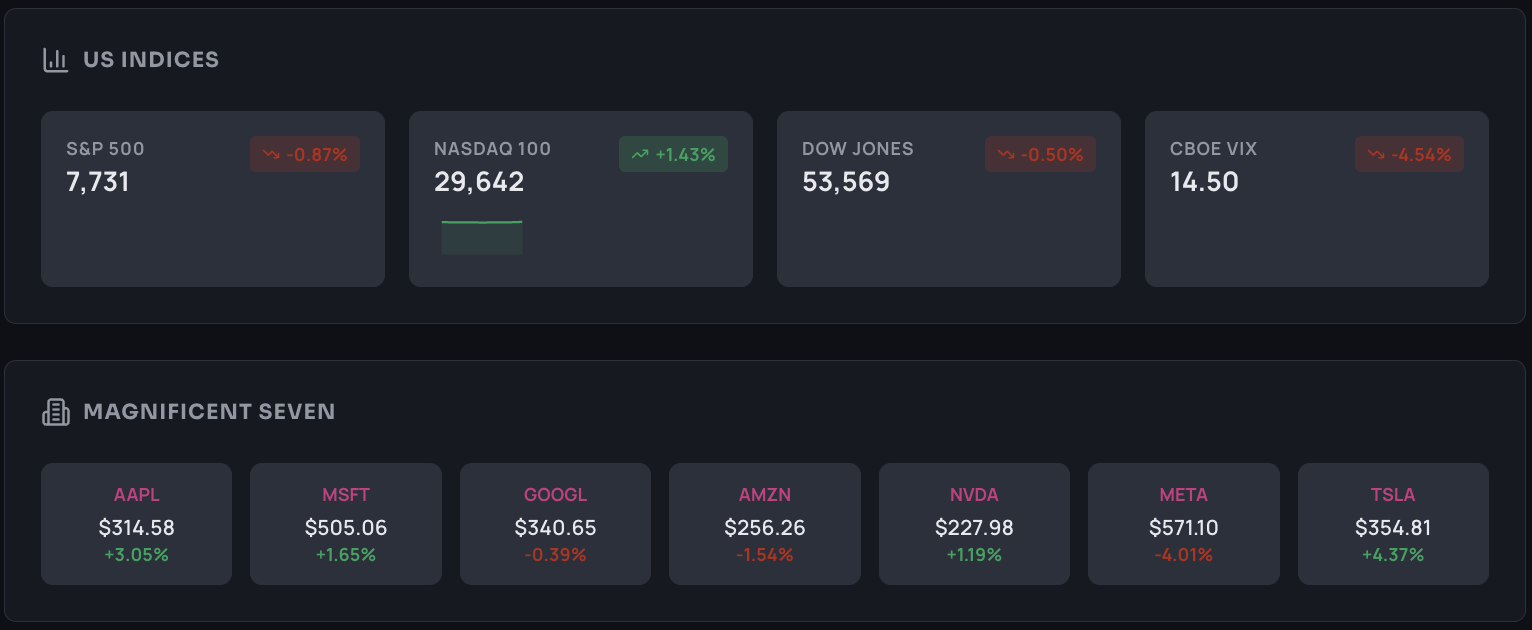
The S&P 500 saw a slight pullback of -0.87%, while the Dow Jones also dipped by -0.50%, suggesting that a selective approach to equities remains prudent as not all sectors are moving in lockstep.
Meanwhile, the Nasdaq demonstrated resilience with a 1.43% gain, indicative of continued strength in specific growth and tech sectors, which often influences investor appetite for riskier assets.
The VIX, a measure of market volatility, declined by 4.54% to 14.50, signaling a reduction in perceived market risk in traditional markets. This calmer backdrop typically supports an environment conducive to risk-taking, which can extend to digital assets.
The US 10-year Treasury yield, holding at 4.672%, saw a minor decrease of -0.51%, maintaining a level that continues to offer competition for capital against growth assets, requiring a balanced perspective on asset allocation.
The Dollar Index (DXY) remained flat at 28.02, but its underlying strength in recent months continues to exert pressure on global liquidity.
The Stocks Lens
Equity markets are showing a nuanced picture, where sector-specific performance is outweighing broad index movements. While the S&P 500 and Dow Jones experienced slight downturns, the Nasdaq 100 continued its upward trajectory with a 1.43% gain, driven largely by the resilience of tech giants.
Nvidia's strong earnings, for instance, played a role in sustaining this positive momentum, indicating that investor capital is gravitating towards companies demonstrating robust growth and profitability.
Tesla (TSLA) led the Magnificent Seven with a 4.37% gain, and Apple (AAPL) was up 3.05%, suggesting a continued preference for innovative, large-cap technology firms. Conversely, Meta (META) saw a 4.01% decline, reminding investors that even market leaders are subject to volatility and sector-specific headwinds.
This dynamic suggests that capital is actively seeking quality and clear growth narratives within equities, with a low VIX implying that investors are not currently panicking over broader market moves, but rather reallocating within favored themes.
This selectivity in equities often means that digital assets with strong institutional narratives, like Bitcoin and Ethereum, can also attract capital as part of a diversified growth strategy
The Crypto Lens
Digital asset markets are currently exhibiting strong institutional-driven momentum, particularly for Bitcoin and Ethereum.
Bitcoin (BTC) is trading near $79,691, showing a slight daily dip of -0.24% but a robust 5.4% gain over the last seven days. This resilience is largely fueled by significant institutional ETF inflows, with a nine-day streak of inflows into Bitcoin ETFs, including BlackRock IBIT's substantial $1.92 billion this week. Ethereum (ETH), currently at $2493.26, mirrored this trend with a 5.3% weekly gain, despite a daily decline of -1.64%.
Ethereum spot ETFs, such as BlackRock ETHA, also recorded substantial inflows, totaling $536.83 million this week. This consistent institutional demand underscores a maturing market where established digital assets are increasingly seen as legitimate components of investment portfolios rather than purely speculative bets.
Bitcoin dominance, holding at 59.2%, signifies that while institutional interest is high, capital within the digital asset ecosystem is largely consolidating into the two largest assets.
This tells us the market is currently rewarding institutional-validated digital asset exposure and punishing unstructured, broad-spectrum altcoin speculation.


Notable Outliers
This period's crypto market saw a strong bifurcation between institutional favorites and highly speculative assets.
Among the top performers, Official Trump (TRUMP) surged 21.03% in 24 hours and a staggering 65.00% over seven days, showing that narrative-driven meme coins can still attract substantial capital.
Stacks (STX) also notably gained 65.40% over seven days, driven by its role in expanding Bitcoin's utility and capturing renewed interest in Bitcoin layer-2 solutions. Conversely, other highly speculative assets like Cash Cat (CASHCAT) and Dog (Bitcoin) (DOG) saw 24-hour declines of 8.83% and 7.80% respectively, despite substantial weekly gains of 62.00% and 75.30%.
This shows that while high-beta altcoins can deliver outsized returns, they also carry significant downside risk and extreme volatility within short timeframes, rewarding investors who are quick to enter and exit.
The underlying driver for these outliers is often speculative sentiment or a transient narrative, contrasting sharply with the sustained institutional demand supporting BTC and ETH.
Sector Spotlight
The Bitcoin Layer-2 sector is gaining traction this period, notably evidenced by Stacks (STX) with a 65.40% gain over the past seven days. This sector's resurgence is driven by the ongoing demand for expanding Bitcoin's functionality beyond a store of value, allowing for smart contracts and decentralized applications.
Investors are increasingly looking to protocols that build directly on Bitcoin's robust security, seeking to leverage its network effect for new use cases. This trend signifies a shift in digital asset allocation towards infrastructure that enhances the utility of core assets.
It appeals to investors seeking exposure to innovation that is anchored to established networks, rather than purely speculative new chains, offering a more portfolio-rational approach to high-growth segments of the digital asset space.
The Contrarian Take
The most dangerous mistake investors are currently making is conflating strong institutional inflows with an absence of risk, leading to an overconfidence that market conditions will remain perpetually favorable.
While ETF inflows are undeniably positive, Bitcoin's current rally is also nearing overbought conditions on momentum indicators, and the VIX shows underlying market caution in traditional finance.
Reacting to the current "Greed" sentiment by increasing exposure beyond a predefined allocation, or chasing the highest-flying altcoins, can expose a portfolio to significant drawdowns when the inevitable consolidation occurs. The structural support from ETFs does not eliminate volatility; it changes its nature.
Disciplined investors remember that every period of strong gains is eventually followed by a period of rebalancing, regardless of the underlying fundamental story.
The ICONOMI Angle
Looking at the ICONOMI strategies this month reveals a clear picture of what capital is rewarding.
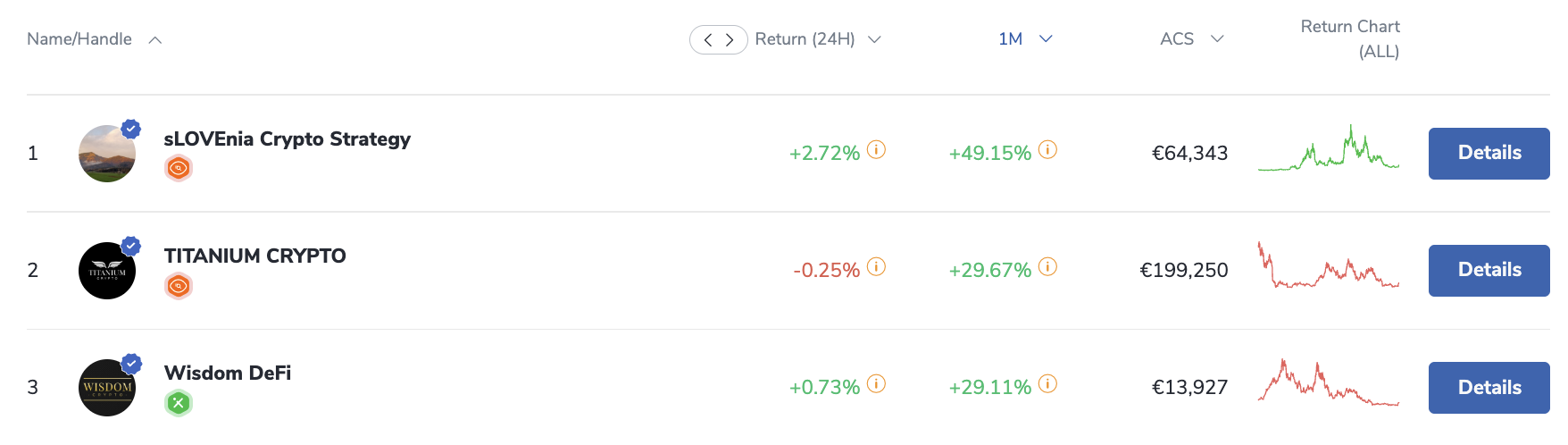
The sLOVEnia Crypto Strategy (SLOVENIA) stands out with a +49.15% 30-day return, primarily driven by its significant allocation to ENA, which made up 49.2% of its holdings. This demonstrates that concentrated exposure to high-growth altcoins, while carrying higher risk, can generate substantial returns in a bullish crypto environment.
TITANIUM CRYPTO, with a +29.67% one-month return, combines a passively managed allocation to BTC and ETH with actively managed high-alpha altcoins. Its largest holdings were SOL at 34.29%, ETH at 24.34%, BTC at 13.95%, and LINK at 7.76%.
Comparing the two top-performing strategies shows that different allocation approaches, from concentrated exposure to a single altcoin to a broader mix of established digital assets and selected altcoins, delivered strong returns during the period.
The Month Ahead
Late August/Early September: Federal Reserve Chairman's speech at Jackson Hole Symposium – Potential insights into monetary policy that could influence global risk appetite.
September (Ongoing): Discussions around Hyperliquid's potential US market entry – Regulatory developments for specific digital asset platforms can indicate broader trends for market access.
September (Ongoing): Continued progress on crypto regulation within the EU (MiCA implementation) – Further clarity can boost investor confidence and institutional participation.
What to Watch Next
One thing to watch is whether the institutional inflow into Bitcoin and Ethereum ETFs maintains its nine-day streak, as this provides a clear signal of sustained demand. Whether this trend continues will depend on the stability of broader macroeconomic factors and any new regulatory announcements. The open question is how long meme coin volatility, exemplified by TRUMP's recent surge, can coexist with this more structured institutional interest without significant capital rotation between the two segments.
Another area to observe is how the tech sector's resilience, as seen in the Nasdaq's performance, might influence the perceived correlation between traditional growth stocks and established digital assets. A continued low VIX could support this environment, but a sudden spike would quickly shift investor focus. Ultimately, the market will reveal whether the current decoupled strength of BTC and ETH against some traditional indices can be sustained, or if broader market dynamics will eventually reassert a tighter correlation.
FAQs
Is it too late to get into crypto now that prices are up?
It is never "too late" or "too early" for a structured allocation. Prices reflect current sentiment, not future potential. The focus should be on aligning digital asset exposure with your overall portfolio strategy, using tools like dollar-cost averaging to manage entry points over time rather than chasing peak momentum.
Should I move all my investments into tech stocks and crypto given their recent performance?
Chasing recent outperformers is a common mistake that can lead to concentrated risk. Diversification across asset classes and within sectors helps protect against unexpected reversals. A disciplined allocation ensures you participate in various market uptrends without overexposing your portfolio to any single narrative.
How does institutional ETF adoption impact my personal crypto holdings?
Institutional adoption, particularly through ETFs, brings significant capital and regulatory scrutiny to digital assets. This increases market legitimacy and liquidity, which can provide a more stable long-term environment for all investors. It signals a shift toward a more mature asset class, benefiting structured allocations.

Ready to start your journey with us?
Trusted by over 100,000 users from around the world.