Monthly Market Wrap June 2026
Extreme Fear, Mild VIX: When Markets Disagree
Crypto spent June slipping while US equities kept their footing. Bitcoin sits at $58,674 after a -6.05% week, a move that tends to punish portfolios built on conviction but no risk budget, while the S&P 500 at 7,440.43 is up +0.12% on the day, rewarding investors who stayed diversified instead of forcing everything through a single risk lens.
News Digest
Bitcoin downside hedging is getting expensive (CoinDesk). Options traders paying up for protection as BTC trades below $60,000 fits a market that is prioritising defence over upside, which usually raises the penalty for reactive exits because liquidity thins exactly when fear peaks. ICONOMI strategy holders feel this most when they concentrate risk in a single asset rather than hold a defined allocation band.
Macro stress shows up via FX, not just rates (CoinTelegraph). USD/JPY at 161.92 and the story of yen weakness keeps reinforcing “global funding stress” as a backdrop, and BTC failing to reclaim $60,000 in that context often signals that crypto is being treated as a funding source, not a safe haven. Portfolios with preset rebalancing rules tend to handle this better than ad hoc decision-making.
A major insurer steps into tokenised credit (CoinDesk). New York Life’s tokenisation debut with an onchain high-yield bond fund is a credibility signal for the “blockchain as infrastructure” thesis, which can support selective sectors even while majors draw down. The implication for ICONOMI investors is simple: adoption narratives can progress even when spot prices are noisy.
Stablecoin rules are fragmenting (The Block). The UK discussing lower stablecoin capital buffers versus EU MiCA-style requirements points to jurisdiction shopping, and fragmented rules tend to show up as stablecoin preference shifts and liquidity migration rather than clean price catalysts. Strategy design benefits from treating stablecoins as plumbing, not a directional view.
MiCA deadlines are reshaping where firms build (MarketWatch). Dubai positioning for inflows as firms reassess Europe reinforces the theme that regulation is now a competitive variable, and that can change which venues attract liquidity. Investors feel it through spreads and market depth, not through headlines alone.
The Macro Lens
Traditional risk gauges look calmer than crypto sentiment. The VIX is 17.74, down -3.80% today, a level that typically aligns with “orderly equity volatility” rather than panic, so the gap between that and crypto’s Extreme Fear reading of 15 suggests crypto is processing its own positioning reset rather than simply following macro.
Rates and the dollar offered mild relief on the day, not a tailwind. US 10Y yields at 4.390, down -0.86%, and DXY down -0.32% remove a bit of pressure that usually squeezes long-duration assets, but crypto still traded heavy, which often happens when investors are de-risking within crypto first and asking macro questions second.
FX stress is still part of the background hum. USD/JPY at 161.92 keeps the conversation anchored on global imbalances, and markets like this tend to reward portfolios that assume these shocks recur, because the timing rarely arrives with a calendar invite.
The Stocks Lens
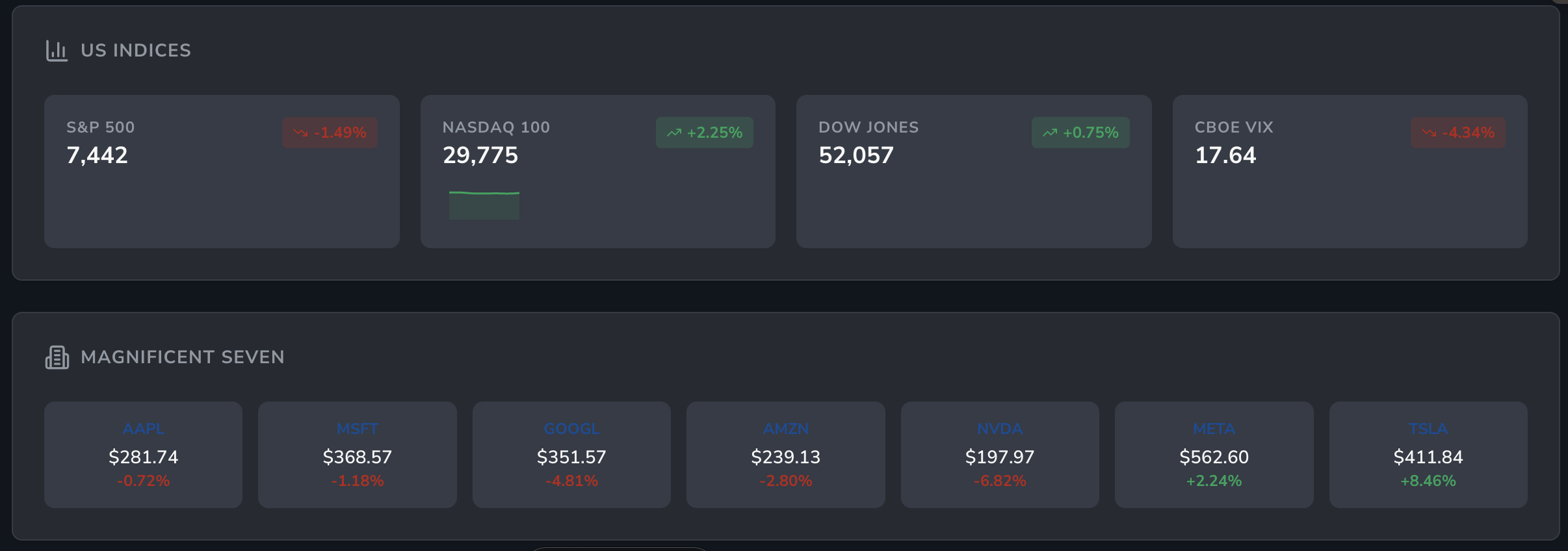
US equities showed a “risk-on, but selective” session. The Nasdaq 100 at 29,774.751 is up +2.25% today, a move that usually encourages investors to chase beta, yet the S&P 500 is only up +0.12% at 7,440.43, which hints that gains are being carried by pockets of leadership rather than broad participation.
That dispersion is visible inside the Magnificent Seven. Alphabet is up +4.82% at $353.65 and Amazon up +3.20% at $240.14, while NVIDIA is down -4.98% at $194.97 and Apple down -3.23% at $281.74, a split that punishes the “all-tech-is-the-same” habit and rewards a portfolio view that spreads exposure across themes instead of anchoring on one story.
For crypto, this kind of equity tape can feel insulting. When equities rally and crypto does not, investors often interpret it as “crypto is broken,” but it usually reads more like capital choosing the cleaner balance sheets and deeper liquidity first, which is exactly when allocation discipline matters more than conviction.
The Crypto Lens
Crypto’s mood is blunt. The Fear and Greed Index at 15 sits in Extreme Fear, a level that tends to coincide with investors checking prices too often and changing plans too quickly, which is how a long-term allocation turns into a sequence of short-term decisions.
Bitcoin at $58,674 is down -2.04% over 24 hours and -6.05% over seven days, and that weekly drift lower often becomes a behavioural trap: people wait for “one green day” as permission, then get shaken out by the next red one. Ethereum at $1,559.89 is down -0.96% over 24 hours and -5.96% over seven days, and the ETH/BTC ratio at 0.0266 signals relative underperformance that usually makes diversified crypto allocations feel uncomfortable because the second-largest asset is not providing leadership.
Dominance is doing its quiet job. BTC dominance at 55.5% is consistent with a risk-off posture inside crypto, where investors prefer the most liquid asset and reduce exposure to the long tail, which is why broad alt exposure often disappoints even when a few names post spectacular wins.


Notable Outliers
This is still a market where isolated tokens can levitate while majors sag, and that contrast is a warning label. Cortex is up +66.11% in 24 hours and +169.43% over seven days, Synapse is up +61.43% in 24 hours and +165.91% over seven days, and TAC is up +13.64% in 24 hours and +213.43% over seven days, a cluster of moves that tends to appear when liquidity is thin and attention is rotating into smaller caps for adrenaline rather than for fundamentals.
Velvet is up +224.58% over seven days while only +2.01% over 24 hours, which often reflects a sharp repricing followed by stabilisation, the phase where late buyers confuse “not falling today” with “risk is gone.” Solstice is down -5.01% over 24 hours despite being up +173.80% over seven days, the classic pattern where the round-trip starts once the easy momentum trade is crowded.
In portfolios, these outliers matter less as “opportunities” and more as signals. When the biggest moves are concentrated in small names while BTC and ETH bleed, the market is often in a barbell of fear and speculation, and that is exactly when pre-set allocation limits stop one exciting candle from rewriting the whole plan.
Sector Spotlight
Tokenised real-world assets are pushing forward even while spot crypto feels fragile. New York Life’s onchain high-yield bond fund debut with Centrifuge reads like institutions testing rails, not chasing hype, and that steady adoption tends to build the kind of base that shows up in infrastructure usage before it shows up in index prices.
This narrative also changes how investors frame digital assets in a portfolio. When blockchains start competing as distribution and settlement layers for familiar instruments, “crypto exposure” becomes less about one coin doing 10x and more about measured allocation to an emerging financial stack, which fits the grown-up investor who wants structure without needing to live inside headlines.
The Contrarian Take
Extreme Fear can be a comfort blanket. A reading of 15 tells investors “everyone is scared,” and that can tempt people into thinking the hard part is over, but fear can persist while prices grind, especially when the market is unwinding leverage and repositioning rather than responding to a single event.
The other underappreciated risk is narrative whiplash. Regulatory divergence stories, like the UK discussing lower stablecoin capital buffers while MiCA pressure reshapes European firm behaviour, can shift liquidity paths in ways that change spreads and execution quality, and that hits real portfolios through slippage and tracking error, not through dramatic price candles.
The ICONOMI Angle
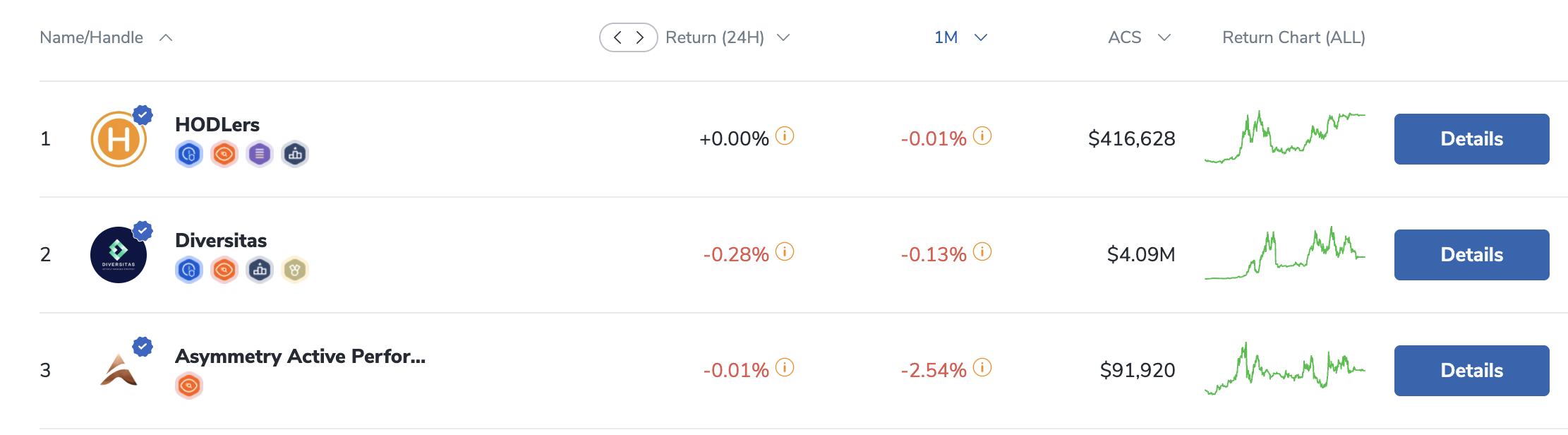
ICONOMI’s 30-day “top performers” list reads like a positioning map of investor psychology. HODLers at +2.30% with 100% USDC and Diversitas at +2.18% with 90% USDC and 10% BTC both did well because holding optionality in a month like this reduces the pressure to make forced decisions on down days. Even the strategies labelled “active” were mostly stablecoins, with MAAX at -0.28% holding 100% USDT and ASYMBIT at -2.41% holding 95.1% USDT and 4.9% BTC, which shows how defensive positioning has been rewarded.
Pecun.io Cryptocurrency at -4.13% with 52.6% PAXG and 47.4% USDC points to a second lesson: hedges can lag or wobble, and a hedge is only useful if it’s sized to stabilise the portfolio rather than to be “right” every week. Across these strategies, the consistent message is that the month rewarded structure and punished impulsive exposure, which is exactly the behaviour gap most investors underestimate.
Risk-adjusted metrics like Sharpe, max drawdown and beta vs BTC were not provided in the dataset, so any ranking by “quality of return” would be guesswork. The visible allocation mix still gives a clear read: stablecoin-heavy structure outperformed because it reduced the cost of being early, and it reduced the odds of capitulating into a bad tape.
The Month Ahead
Monthly macro prints and central bank messaging (next 30 days): US 10Y yields at 4.390 are already moving day to day, so any shift in rate expectations can reprice risk quickly.
ETF flow updates for BTC and ETH: flows have been mixed, and week-to-week changes often move sentiment even when spot price is slow.
Stablecoin regulatory headlines (UK vs EU): rule changes tend to show up first in stablecoin preference and liquidity conditions.
Tokenisation launches and institutional pilots: each credible launch reinforces the infrastructure narrative, which can support selective segments despite weak majors.
What to Watch Next
Whether BTC dominance stays elevated around 55.5%: sustained dominance usually keeps broad alt exposure under pressure even if a few tokens surge.
Whether equity calm persists with VIX near 17.74: a low VIX alongside crypto fear can continue the “divergence” regime where diversification does the heavy lifting.
ETH relative strength via ETH/BTC at 0.0266: stabilisation often matters more than a single up day because it changes portfolio leadership inside crypto.
Stablecoin liquidity as dry powder: stablecoin supply trends can hint at readiness to redeploy risk, even when sentiment is still negative.
FAQs
Why is crypto in Extreme Fear while stocks are rising?
Crypto can diverge when it is unwinding its own positioning. With Fear and Greed at 15 while the Nasdaq 100 is up +2.25% and VIX is 17.74, equities are pricing orderly risk, while crypto is pricing internal de-risking, thinner liquidity and demand for downside protection.
What does BTC dominance at 55.5% signal for altcoins?
BTC dominance at 55.5% signals risk-off behaviour inside crypto. Investors tend to prefer the most liquid asset and reduce exposure to smaller names, which often leaves “average” altcoin baskets lagging even when a few outliers post triple-digit weekly gains.
Does a stablecoin-heavy strategy mean investors are timing the market?
A stablecoin-heavy strategy often reflects risk budgeting rather than prediction. When BTC is down -6.05% on the week and sentiment is at Extreme Fear, holding more USDC or USDT can keep optionality high, reducing the chance of forced selling during volatile sessions.

Ready to start your journey with us?
Trusted by over 100,000 users from around the world.