How To Buy Cryptocurrency: Credit Card, Bank Transfer, And Other Payment Methods
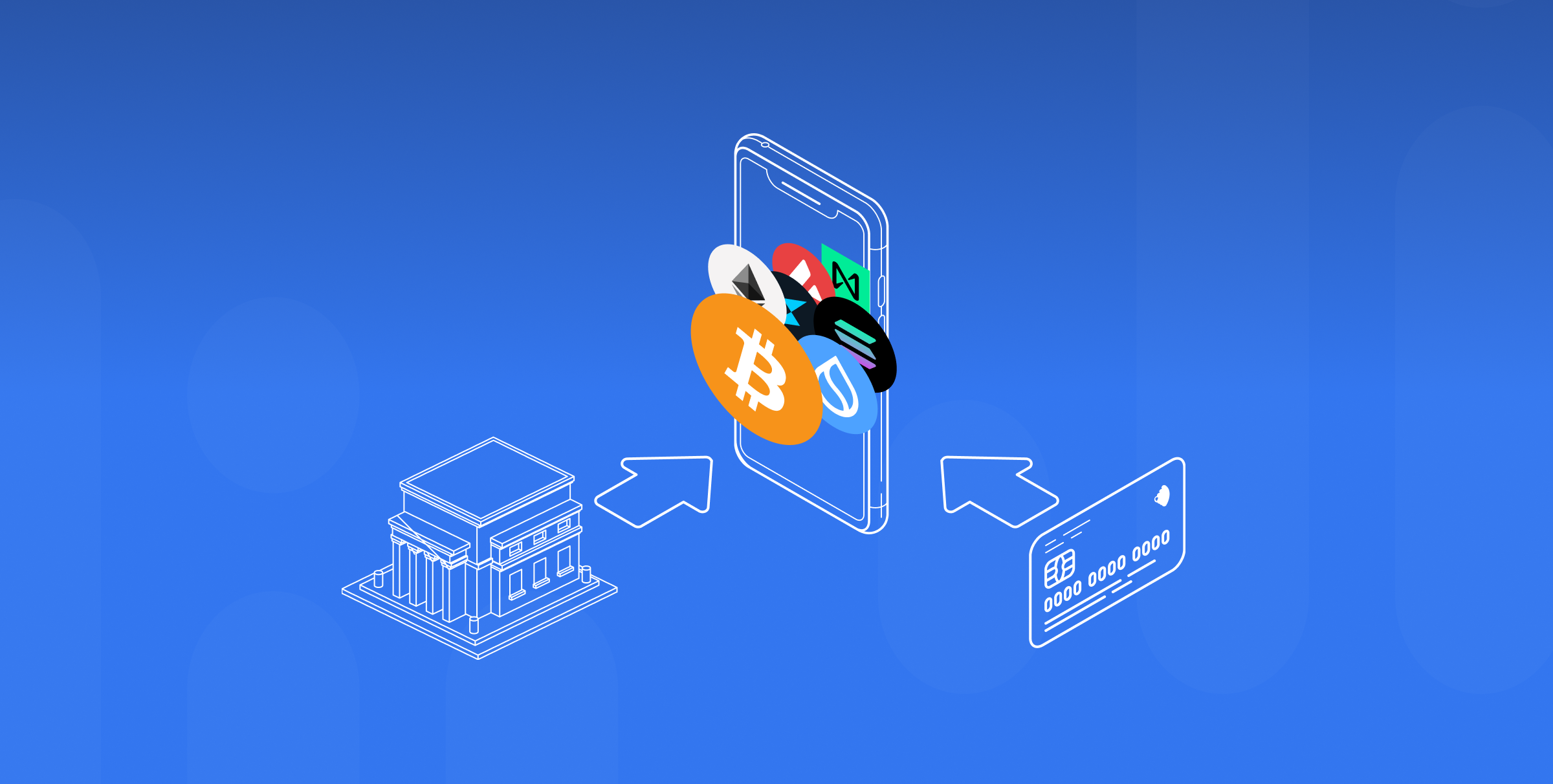
Buying crypto is simply the process of turning everyday money into digital assets. You choose what you want to buy, pay with a supported method, and receive crypto in your account or wallet through a fiat to crypto on-ramp.
The tricky part is choosing how to pay. There’s no single “best” option, because crypto payment methods always involve trade-offs between speed, cost, and approval likelihood.
Card payments are usually the quickest route and can feel almost instant. The downside is that they often come with higher fees, and some banks may decline the transaction. Bank transfer is often cheaper and can support higher limits. But it’s not always immediate, and delivery can take 1–3 business days depending on your bank and region.
Mobile wallets can make checkout smoother on your phone. They still typically run through card rails, so the same issuer rules and fees can apply. And if you’re using local payment methods, expect options to vary by country and provider.
The key is knowing what you’re paying, how long it should take, and where your crypto will land.
A good fiat to crypto on-ramp makes getting started straightforward. A solid off-ramp matters just as much, because it means you can cash out when you need to, without surprises.
Key Notes
Cryptocurrency purchases are facilitated through various payment methods—credit/debit cards, bank transfers, and mobile or local payment solutions—each with specific trade-offs in speed, cost, and approval rates.
Comprehensive KYC verification, transparent fee breakdowns (including spreads, FX, and network fees), and careful selection between custodial and self-custodial delivery are critical steps before buying.
Payment failures are commonly caused by bank policies, fraud prevention checks, and data mismatches, and can often be resolved by switching payment methods or contacting the provider.
Security best practices include using trusted platforms, enabling 2FA, verifying wallet addresses, starting with small test purchases, and monitoring for scams and phishing risks.
Before You Buy: What You’ll Need (And What To Check)
Before you make your first purchase, it’s worth doing a quick pre-flight check. A couple of simple decisions now, like where your crypto should land and what fees you’ll actually pay, can save you a lot of hassle later.
Choose where you want the crypto delivered
Decide if you want a custodial exchange balance or self-custody. A custodial exchange holds crypto for you inside an account.
Self-custody means delivery to your wallet address. With a wallet address, you must select the correct network to avoid losses. Non-custodial wallet delivery puts you in control, but increases responsibility. If you are new, start simple and upgrade to self-custody when confident.
KYC verification and why it’s required
Most regulated platforms require KYC verification before you can buy. This is part of AML compliance checks, which help prevent fraud and financial crime. Expect to provide ID and basic personal details when creating your log in or registering in the platform. Mind that some purchases will trigger extra security checks, especially higher amounts.
The KYC verification process also protects approval rates on card payments, so passing through it will reduce chances of payment denied. Note also that AML compliance requirements will vary by region and provider.
Understand the total cost before you click “confirm”
Your total cost can include transaction fees and crypto fees. You may also pay spreads, foreign exchange fees, and network fees. Spreads are the gap between the quote and the market price. Network fees apply when crypto moves on-chain to a wallet address. Always review the quote line-by-line before confirming. Cost clarity matters more than a “low headline fee”.
How To Buy Crypto On ICONOMI (Quick Start)
On ICONOMI, you can buy crypto assets and also invest in Crypto Strategies. That lets you choose a single asset or a diversified approach.
Here's a breakdown of the buying process:
- Create your ICONOMI account and secure it with strong login settings.
- Complete identity verification when prompted for compliance.
- Choose what you want to buy and enter an amount in your currency.
- Select a payment method from the options available in your region.
- Review the quote, fees, and the final amount you will receive.
- Confirm the purchase and track status until completion.
If your purchase is delivered to an ICONOMI account, it is custodial by default. If a flow asks for a wallet address, double-check the network and address.
How To Buy Crypto With A Credit Card (Step-By-Step)
You can buy crypto with credit card on many regulated platforms.
For many beginners, it is the fastest way to buy cryptocurrency with credit card.
Step 1: Choose a reputable provider with clear compliance and support.
Expect regional limits and issuer restrictions.
Step 2: Pick the asset and amount.
You can usually buy fractions, including when you buy Bitcoin with credit card.
Step 3: Complete KYC verification and any card checks.
Most card purchases require 3D Secure (3DS) via an OTP or banking app.
Step 4: Review the quote for fees, spreads, and FX fees.
Card pricing often includes a convenience premium.
Step 5: Confirm and receive crypto.
Delivery can be minutes, including when you buy Ethereum with credit card.
If you plan to buy crypto with credit card regularly, monitor limits.
Repeated declines can indicate issuer policy, not a problem with your details.
How To Buy Crypto With A Debit Card (And Why It’s Often Easier)
To buy crypto with debit card, the checkout flow looks similar to credit cards.
The key difference is how banks treat the risk and funding source.
Debit cards use your existing account balance, not borrowed credit.
That can improve approval rates, especially for first-time buyers.
You will still see fraud checks and 3D Secure prompts.
You may still pay spreads and transaction fees, depending on the provider.
Step-by-step is straightforward: choose asset, enter amount, verify identity, pay.
Then receive crypto to a custodial exchange balance or wallet delivery address.
If you cannot buy crypto with credit card, try debit first.
Many users can buy crypto with debit card even when credit is blocked.
How To Buy Crypto With A Bank Transfer (Often Cheaper, Sometimes Slower)
If cost is your priority, buy crypto with bank transfer where possible.
Bank rails often reduce card processing cost and chargeback risk.
In the UK, Faster Payments (UK) can support near-real-time transfers.
In the EU, a SEPA transfer (EU) is common for EUR deposits and withdrawals.
Typical flow: initiate a transfer, wait for funds to arrive, then place your buy.
Some platforms auto-convert on receipt, but many let you choose timing.
Always use the correct reference and beneficiary details.
Mismatches can delay settlement and trigger compliance reviews.
Timeframes vary: some transfers are same day, others 1–3 business days.
Cut-off times and weekends matter for Faster Payments (UK) and SEPA transfer (EU).
For larger amounts, bank transfer limits are often higher than cards.
That is why many experienced users buy crypto with bank transfer.
Buying Crypto With Apple Pay, Google Pay, And PayPal (Where Available)
Apple Pay and Google Pay
To buy crypto with Apple Pay, you typically use a linked card for fast checkout.
To buy crypto with Google Pay, the setup is similar, with fewer manual steps.
Approval still depends on the underlying card issuer.
Fees can resemble card pricing, including spreads and FX fees.
These methods can be ideal for small, time-sensitive buys.
They are not always available in every country or for every asset.
If offered, they can speed up Web3 onboarding from mobile devices.
Still review the quote and the final received amount.
PayPal
To buy crypto with PayPal, availability depends on provider and country.
Where supported, PayPal can simplify funding and reduce typing errors.
However, PayPal can have distinct limits, fees, and withdrawal rules.
Always read whether you can send crypto to a wallet address or only hold it.
If you cannot buy crypto with PayPal, use card or bank transfer instead.
You can still buy crypto with PayPal in some regions, but not universally.
Other Payment Options: E-Wallets And Local Methods
Some regions support e-wallets or alternative checkout methods.
These can include local bank rails and other payment apps.
The value is coverage: a local payment method can outperform cards in approval.
The trade-off can be fees, tighter limits, or slower settlement.
Always compare crypto payment methods on three points:
Cost, delivery time, and refund or dispute handling.
Check whether the purchase is custodial or wallet delivery.
That determines whether you need to manage a wallet address immediately.
Also confirm whether the method supports recurring payments.
Not every local rail supports a recurring buy schedule.
Fees, Spreads, Limits, And Speed: What You Really Pay
Cost is rarely a single line item.
It is a bundle of fees, spreads, and sometimes FX fees.
Transaction fees can include provider service fees and card processing.
Spreads are embedded in the rate and can widen in volatile markets.
FX fees apply when you pay in one currency and settle in another.
Network fees apply if crypto is sent on-chain to a wallet address.
Look for transparent pricing that shows the breakdown before you confirm.
Transparent pricing reduces surprises after the trade executes.
Some checkouts use rate locking for a short period.
Rate locking protects you from price movement during payment authorisation.
Limits vary by method, region, and account history.
Cards are often lower-limit than bank transfer, especially at the start.
Why Card Payments Fail (And How To Fix Them)
A credit card crypto purchase declined message is common, even on good platforms.
Many declines are issuer-led, not a “wrong button” issue.
Common causes include:
Bank policy, fraud checks, merchant category restrictions, or insufficient limits.
This is also why banks block crypto credit card purchases in some regions.
Some issuers treat crypto as “cash-like” and restrict it.
3D Secure failures can also trigger declines.
Name or address mismatch can cause automated rejections.
Fix checklist:
Try a smaller amount, retry 3D Secure, and ensure your details match exactly.
If the credit card crypto purchase declined again, switch rails.
Use debit, open banking, or bank transfer to complete the purchase.
If you suspect policy blocks, call your bank and ask to allow the merchant.
It helps to ask directly why banks block crypto credit card purchases on your account.
Safety Checklist: A Safe Way To Buy Crypto (And Avoid Scams)
The safe way to buy crypto starts with basic hygiene.
Use official apps and domains, and ignore “support” messages you did not request.
Enable 2FA and use a unique password.
Treat email inbox security as part of your crypto security.
Always verify the wallet address before sending funds.
If you use wallet delivery, confirm the correct network twice.
Start with a small test purchase.
This is the simplest way to avoid crypto scams tied to address mistakes.
Watch for phishing pages that mimic checkout screens.
Bookmark trusted URLs to avoid crypto scams via search ads.
Keep records of quotes and confirmations.
They help if you need support for delays or chargebacks disputes.
Crypto is volatile, and transactions can be irreversible.
Never buy more than you can afford to lose.
One-Time Buy Vs Recurring Buys (DCA)
A one-time buy is simple, but timing markets is hard.
A recurring buy plan reduces timing pressure.
Dollar-cost averaging (DCA) spreads purchases over time.
It can smooth entry price, but it does not remove risk.
A recurring buy can be weekly or monthly, funded by card or bank transfer.
Choose a schedule that fits your budget and cashflow.
DCA works best with clear rules and realistic limits.
Do not increase amounts impulsively after short-term price moves.
Review your costs regularly.
Fees and spreads compound when you run a recurring buy over months.
If your goal is long-term exposure, DCA can be practical.
If your goal is short-term trading, you may prioritise lower fees per trade.
FAQs: Buying Crypto With Credit Cards And Other Payment Methods
Can I buy crypto with a credit card?
Yes, in many regions you can buy crypto with credit card after KYC verification and 3D Secure (3DS).
Why can’t I buy crypto with my credit card or bank?
Issuer policies and fraud checks are common. This is why banks block crypto credit card purchases for some customers.
Is it safe to buy cryptocurrency with credit card?
It can be safe on regulated platforms with encryption, PCI-style controls, and strong fraud teams. You still must avoid phishing and verify any wallet address.
How long does it take to receive crypto?
Card purchases are often instant or within minutes. Bank transfer can be same day or 1–3 business days, including Faster Payments (UK) and SEPA transfer (EU).
Can I buy Bitcoin with credit card and buy Ethereum with credit card?
Usually yes, subject to platform listings and local rules. Most services allow fractional purchases of BTC and ETH.
Can I use Apple Pay, Google Pay, or PayPal?
Sometimes. You may be able to buy crypto with Apple Pay, buy crypto with Google Pay, or buy crypto with PayPal, but availability varies by country and provider.
Can I use credit card rewards?
Some issuers allow it, others exclude “cash-like” purchases. Check your card terms before you buy cryptocurrency with credit card.
Can I pay my credit card bill with crypto?
It depends on your card provider and region. Many issuers require fiat repayment, so you may need a crypto off-ramp to convert crypto to fiat first.
Choose The Payment Method That Fits Your Priorities
To buy crypto, pick the route that matches your priorities: speed, cost, or approval.
Credit cards are fast, bank transfer is often cheaper, and mobile wallets can simplify checkout.
Always review fees, spreads, FX fees, and network fees before confirming.
If a payment fails, switch rails and follow a clear troubleshooting checklist.
On ICONOMI, you can buy cryptoassets or invest in Crypto Strategies after verification.
Choose the payment method available to you, confirm the quote, and track delivery.
Crypto carries risk and volatility, and this is not financial advice.
Stay security-first, start small, and build confidence step by step.

Ready to start your journey with us?
Trusted by over 100,000 users from around the world.